
Table of Contents
- Understanding LADWP Heat Pump Rebates per Ton in Culver City, California
- How LADWP Heat Pump Rebates Work
- Efficiency Ratings and Heat Pump Rebate Tiers
- Maximizing Your Savings: Rebate Stacking and Federal Tax Credits
- Optimizing Heat Pump Performance and Rebate Eligibility
- Frequently Asked Questions About LADWP Heat Pump Rebates
- Take the Next Step Toward Rebate-Supported Heat Pump Installation
Understanding LADWP Heat Pump Rebates per Ton in Culver City, California
When you explore the LADWP heat pump rebate per ton in Culver City, you’re already aware that a heat pump represents a significant investment in year-round indoor comfort. The Los Angeles Department of Water and Power (LADWP) is the local utility serving Culver City and the surrounding Los Angeles area, and its heat pump rebate program is built around the capacity of the equipment, measured in tons. Because the rebate scales with the system’s size, choosing the right tonnage isn’t only about matching your home’s heating and cooling load, it also directly affects your financial benefit.
Culver City Heating & Cooling Climate Control has been helping Culver City homeowners make smart heat pump choices since 1998. Our certified technicians evaluate your property’s unique requirements and recommend an eligible heat pump that qualifies for the LADWP incentive and delivers reliable, efficient performance. We manage the entire journey, from proper sizing and installation to the final rebate paperwork, so you can maximize your return while enjoying consistent comfort.
Figuring out how the per-ton rebate is calculated and what steps you need to take can feel overwhelming, but it doesn’t have to be. We make sure you understand exactly what you qualify for and walk you through the application process, turning a complex incentive into a straightforward benefit. With the right guidance, your heat pump upgrade becomes a wise, rewarding choice.
How LADWP Heat Pump Rebates Work
Here’s how the utility’s heat pump rebates work for homeowners in Culver City. LADWP determines rebate amounts based on the rated cooling capacity of the system, measured in tons. A qualifying 3-ton heat pump earns a larger total rebate than a 2-ton unit, meaning the size of your system impacts the rebate amount. Below is an explanation of how LADWP’s rebate process works, starting with the per-ton rebate calculation.
Eligibility and the Claim Process
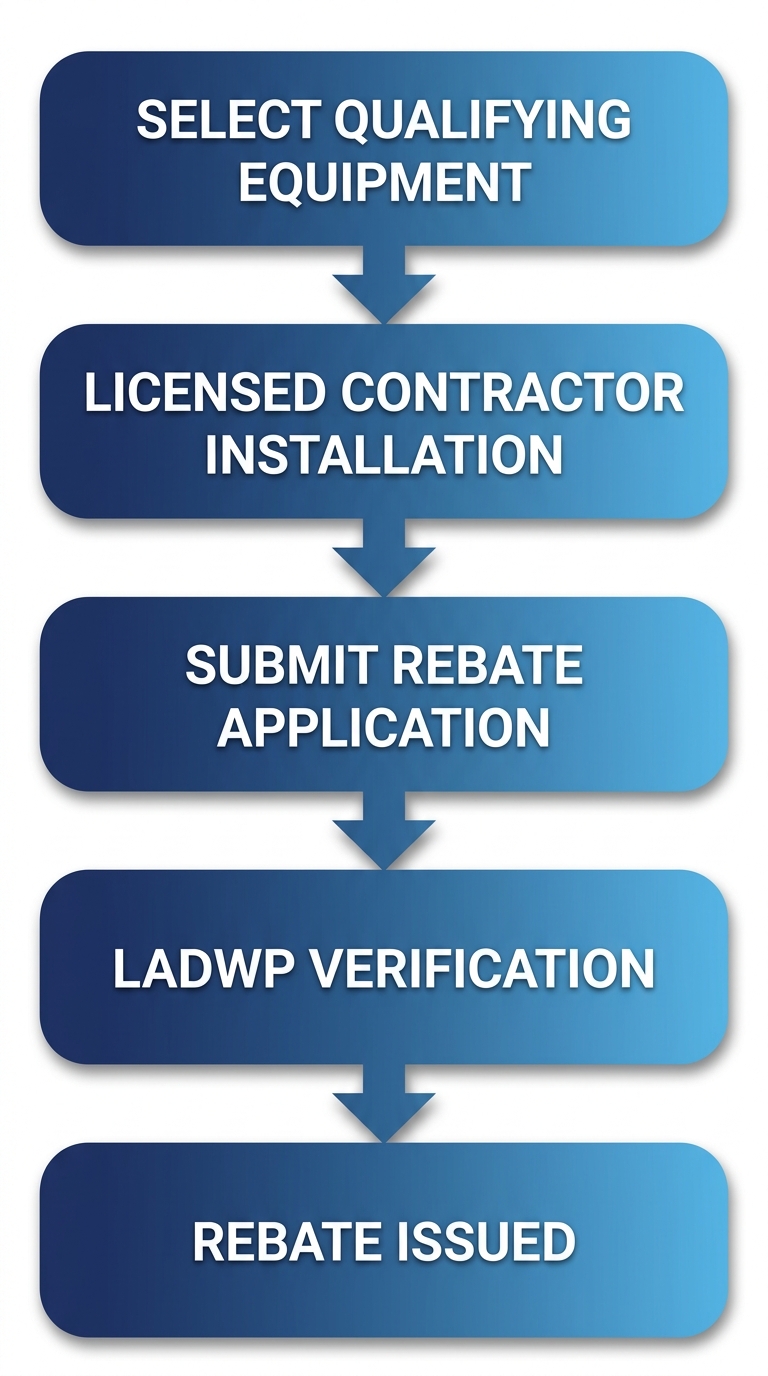
Qualification begins with selecting equipment that meets the utility’s minimum efficiency thresholds for both cooling and heating performance. After the qualifying system is chosen, the claim process is rather straightforward and includes the following steps:
- A licensed contractor installs the heat pump in your home in Culver City or the surrounding Los Angeles area.
- After installation, either you or the contractor submits the rebate application to LADWP, including proof of installation and equipment specifications.
- LADWP reviews the submission and, upon approval, issues the rebate payment.
Because this rebate is issued after the fact, there is no up-front discount at the time of purchase. The amount of time between the submission of the application and the rebate payment is determined by the utility’s current processing schedule and the terms of the program.
What Determines Your Rebate Tier
The size of the per-ton rebate depends on which efficiency tier your heat pump achieves. Systems with higher SEER2 cooling efficiency and HSPF2 heating efficiency qualify for more generous per-ton incentive amounts. LADWP publishes a schedule of tier requirements and corresponding rebate values, and those values are subject to change under program updates. Standard-efficiency split systems typically fall into a baseline tier, while mid-tier and premium systems, including high-efficiency or cold-climate heat pumps, earn progressively higher per-ton rebates.
How high a system ranks, and therefore the exact rebate amount per ton, is dictated by its efficiency ratings, which we discuss further when we examine how SEER2 and HSPF2 requirements influence rebate eligibility.
Your Installation Partner in Culver City
We at Culver City Heating & Cooling Climate Control install qualifying heat pump systems throughout Culver City and the Los Angeles area. Our knowledgeable staff can walk you through the LADWP eligibility requirements during the installation process. Rebate eligibility remains subject to LADWP’s final determination based on their program requirements and terms. However, having a knowledgeable and trained staff means that your equipment and program documentation meet the requirements of the rebate program.
Efficiency Ratings and Heat Pump Rebate Tiers
Because LADWP structures rebates around efficiency tiers, determining the correct SEER2 and HSPF2 numbers is the first step in calculating your per-ton rebate.
Understanding SEER2 and HSPF2 Metrics
SEER2 stands for Seasonal Energy Efficiency Ratio 2, measured under updated Department of Energy test procedures introduced in 2023. Because the test conditions are more rigorous, the resulting SEER2 and HSPF2 numbers are lower than their SEER and HSPF counterparts, this does not mean equipment has become less efficient, only that the testing standard has changed.
LADWP has aligned with industry standards and adopted the new DOE metrics for rebates. Our Culver City technicians confirm equipment ratings against the AHRI directory, which LADWP uses to confirm rebate qualifications. The exact SEER2 and HSPF2 values for a specific model are listed on its AHRI certificate. The SEER2 and HSPF2 values are helpful to a consumer when determining the potential rebate for a given system.
How SEER2 and HSPF2 Affect Your Rebate Per Ton
LADWP’s rebate structure is tiered. As efficiency ratings improve, the per-ton rebate also improves. This is where the per-ton rebate becomes clear. Incremental improvements in SEER2 or HSPF2 can move a system into a higher tier, increasing the per-ton rebate for the installation.
Rebate verification relies on the AHRI certificate number, not marketing materials. We cross-reference the certificate against the utility’s published thresholds to confirm which tier a selected unit falls into. For example, a ductless mini-split with a SEER2 of 15.2 might qualify for a base rebate tier, while the same system with a SEER2 of 16.0 could step into a higher tier; a 0.5–1.0 SEER2 improvement is often enough to change tiers for certain capacity ranges.
Ductless Mini-Split vs Central Heat Pump Rebate Comparison
The type of heat pump system you choose — ductless mini-split or central — affects achievable efficiency ratings and, consequently, rebate tier. Ductless mini-splits typically register higher SEER2 and HSPF2 values because they avoid the energy losses associated with ductwork, while central heat pumps deliver whole-home comfort through existing ducts.
| System Type | Typical SEER2 Range | Typical HSPF2 Range | LADWP Rebate Per Ton | Federal Tax Credit Eligibility |
|---|---|---|---|---|
| Ductless Mini-Split | 20–38 | 10–14 | Varies by tier — see LADWP schedule | Eligible if meets CEE highest-tier criteria; typically stricter than LADWP tiers |
| Central Heat Pump | 14–22 | 7–10 | Varies by tier — see LADWP schedule | Eligible if meets CEE highest-tier criteria; typically stricter than LADWP tiers |
As the table shows, ductless systems can reach SEER2 ratings into the 30s and HSPF2 up to 14, which often places them in upper rebate tiers. Central heat pumps commonly fall between SEER2 14 and 22 and may still qualify for meaningful rebates.
Federal tax credit eligibility depends on meeting the CEE highest-tier criteria, which are typically more stringent than LADWP’s minimum rebate tiers. A unit that earns an LADWP rebate might not satisfy the requirements for the federal 25C credit, so homeowners should evaluate both programs when finalizing an upgrade plan.
Maximizing Your Savings: Rebate Stacking and Federal Tax Credits
Once you know which efficiency tier your prospective heat pump falls into, the real opportunity lies in combining the utility’s per-ton incentive with the federal tax credit. Homeowners in Culver City and the Los Angeles area can claim both programs for the same installation — they are separate incentives that add together rather than cancel each other.
Can You Combine the LADWP Rebate with Federal Tax Credits?
Yes. the utility’s per-ton rebate and the federal 25C Energy Efficient Home Improvement Credit operate independently, so they can be stacked. To qualify, the heat pump must appear on LADWP’s current eligible-equipment list and meet the SEER2/HSPF2 thresholds that determine the rebate tier — a base amount and a higher tier for high-efficiency models. The federal credit further requires installation by a licensed contractor, exactly the kind of professional work our certified technicians perform every day.
The rebate per ton is set by the tier, so the more efficient the heat pump, the higher the per-ton rate, up to the program’s maximum. The federal credit equals 30 percent of the installed cost but is subject to the program’s annual dollar limit.
Calculating Total Savings from Rebate Stacking
To make the math concrete, the following table shows three representative heat pump types for a typical 3-ton installation. All figures are estimates that depend on current program rules and assumed system pricing; actual savings will reflect your specific equipment and installation cost.
| Heat Pump Type | SEER2 / HSPF2 | LADWP Rebate Per Ton | Federal Tax Credit (30%) | Total Estimated Savings |
|---|---|---|---|---|
| Standard Single-Stage | 15 / 8.5 | $150 | $2,000 (capped) | $2,450 |
| Mid-Range Two-Stage | 17 / 9.5 | $300 | $2,000 (capped) | $2,900 |
| High-Efficiency Variable-Speed | 20 / 11 | $300 | $2,000 (capped) | $2,900 |
Because the federal credit caps at the same annual maximum for all three scenarios, moving from a mid-range two-stage model to a top-tier variable-speed unit does not increase the total dollar amount of combined incentives, even though the higher per-ton LADWP rebate has already been captured.
After installation, submit the rebate application with your invoice, the model number, and your contractor’s information. Then, claim the federal credit when you file taxes by using the appropriate IRS form; keep the manufacturer’s certification statement and the itemized invoice in your records.
Selecting the Right Heat Pump to Optimize Combined Incentives
The sweet spot for incentives often sits at the threshold that moves a heat pump into a higher rebate tier while still qualifying for the full federal credit. A mid-range two-stage model that meets the higher SEER2/HSPF2 benchmarks can capture the elevated per-ton rebate and the 30 percent federal credit, often at a more accessible installed cost than the very highest efficiency variable-speed system. We never recommend chasing ratings just for a rebate — the right balance considers your home’s comfort needs, the equipment’s long-term energy savings, and the incremental upfront cost.
Every installation we perform focuses on verifying eligibility upfront, so you know exactly which incentives will apply before the work begins. By pairing our local knowledge of the program’s requirements with professionally installed equipment, we help Culver City and Los Angeles area homeowners maximize the financial advantages available today.
Optimizing Heat Pump Performance and Rebate Eligibility
The program determines heat pump incentives based on system size and efficiency. The size and efficiency of a new heat pump directly affect the total per-ton incentive a Culver City homeowner may receive through the LADWP program. A system’s rated SEER2 (seasonal energy efficiency ratio) is the efficiency it is rated to achieve. An oversized system short-cycles and never reaches its rated SEER2 efficiency. Because of this, it’s important to right-size your system to the actual load.
As a general guide, a 1,000- to 1,500-square-foot home often pairs with 2- to 2.5 tons, while 2,500-square-foot and larger homes may need 4 tons or more. These ranges are starting points. A Manual J load calculation performed by a certified technician is the definitive method for matching equipment to a home’s unique construction, insulation, and air leakage — and we include professional load calculations with every installation we perform in Culver City.
The program requires heat pumps to meet a minimum SEER2 threshold, and the per-ton rebate amount set by the utility changes from one program cycle to the next. Homeowners should verify the current efficiency floor and incentive range directly with LADWP before making a final equipment choice.
To be eligible for the rebate, a system must be installed by a licensed, code-compliant technician. Our licensed technicians ensure that refrigerant charge and airflow are correct, as well as sealed ductwork and thermostat placement. This allows the system to achieve the rated efficiency required by the program. Efficiency is preserved with periodic maintenance, which includes: an annual check of refrigerant levels, clean coils, sealed ductwork and thermostat calibration. These help ensure the equipment remains in the performance window that supports compliance with the terms of the incentive.
In order to make the process easy and enjoyable for Culver City families, we handle the heavy lifting and provide ongoing tune-up plans that protect both comfort and rebate qualification.
The natural questions raised about the per ton rebate and system size and efficiency help illustrate the processes for verifying eligibility, timing of the application and the paperwork. The right foundation of system installation and maintenance helps clarify and streamline the processes.
Frequently Asked Questions About LADWP Heat Pump Rebates
How is the LADWP heat pump rebate calculated?
The rebate is based on your heat pump’s rated capacity in tons, and LADWP publishes a current per-ton schedule. We can help you understand how that per-ton structure applies to your installation.
Who qualifies for the LADWP heat pump rebate?
Homes in Culver City and the surrounding Los Angeles area with LADWP service qualify when they install an eligible heat pump through a licensed contractor. Our certified technicians follow all program requirements during installation.
What does the rebate application and verification process involve?
After installation, we help you submit documentation to LADWP. While we can’t guarantee approval, we guide you through the verification and rebate process.
Can the LADWP rebate be combined with other incentives?
Other incentives may be available, but program terms change; confirm directly with LADWP.
Take the Next Step Toward Rebate-Supported Heat Pump Installation
You understand the rebate details? We can help with the rest. Using the per-ton rebate, we can significantly lower your installation costs.
Since 1998, our certified technicians have been installing heat pumps throughout Culver City and the Los Angeles area. We service all major HVAC brands. If you’re not happy, we’ll work to make it right. Give us a call at (424) 543-6788 or request a quote to schedule your installation and start enjoying rebate-supported comfort.
Start Your Heat Pump Installation
Now that you understand how the LADWP heat pump rebate per ton works, you’re ready to maximize your savings on a new installation. Matching your home to the right system size and efficiency tier is essential to capture the full per-ton incentive. Our certified technicians in Culver City and the Los Angeles area can help you navigate the rebate application and ensure your heat pump qualifies for the highest possible rebate. Since we have been serving local homeowners since 1998, you can trust us to deliver a hassle-free, professionally installed system. We handle everything from equipment selection to the final paperwork, so you can enjoy comfort and lower utility bills. Reach out to discuss your project and get a personalized quote tailored to your home’s needs. Contact us today and take the next step toward an energy-efficient, rebate-supported heat pump.