
Table of Contents
- Understanding HVAC Diagnostic Fees in Los Angeles
- What a Standard HVAC Diagnostic Fee Covers
- Factors That Influence HVAC Diagnostic Fee Pricing
- Getting the Most from Your HVAC Diagnostic Visit
- Understanding Diagnostic Fee Structures for Informed Decisions
- HVAC Diagnostic Fee Questions Answered
- Making Informed Decisions About HVAC Diagnostic Services
Understanding HVAC Diagnostic Fees in Los Angeles
An HVAC diagnostic fee is the first step toward identifying and resolving climate control issues in your home. When you schedule a diagnostic visit with our team, a trusted provider of HVAC services in Culver City, this fee covers a thorough inspection that goes far beyond a simple service call. Our highly-trained technicians perform a multi-point checklist to test critical components, measure system performance, and diagnose underlying problems—whether they stem from worn parts, refrigerant levels, or airflow restrictions. This evaluation reflects the expertise you can expect from a customer-focused heating and air-conditioning company that has served Los Angeles since 1998.
Our hvac diagnostic fee is designed to be applied toward the final repair cost if you choose to proceed with our recommendation—a common practice that ensures you only pay for meaningful work. Unlike a basic service call, where a technician simply arrives at your door, our diagnostic visit includes a system-wide evaluation that accounts for critical variables like your equipment’s age, type, and current condition. That’s why we invest in highly-trained technicians and professional diagnostic tools: a thorough system inspection charge gives you an accurate, no-obligation written estimate before any work begins. In the Los Angeles area, this transparent process is standard among reputable HVAC companies because it protects homeowners from guesswork and unnecessary expenses.
What a Standard HVAC Diagnostic Fee Covers
When you schedule a service call for a malfunctioning system, our standard hvac diagnostic fee covers a thorough evaluation of your equipment. Whether you need AC repair in Malibu or a routine maintenance check, our diagnostic visit includes several critical checks designed to pinpoint the root cause of any performance issue. As outlined in our FAQ, this flat-rate evaluation provides a transparent foundation before any repair work begins.
During a typical diagnostic appointment, our highly-trained technicians perform a visual inspection of your HVAC unit, measure temperature differentials to assess heating or cooling output, conduct an electrical safety check of all visible components, clean or adjust filters as needed, and test your thermostat’s operation. Refrigerant pressure checks are also often included when the system’s service ports are readily accessible; however, if partial disassembly is necessary to reach sealed components, an additional charge may apply. These baseline steps help us quickly identify whether a simple fix or a more involved repair is required.
The following comparison table separates what is included in our standard diagnostic fee from services that may involve an additional charge.
| Included in Standard Diagnostic Fee | Not Included / Additional Charge |
|---|---|
| Visual inspection of HVAC equipment | Full system performance testing (may be billed separately) |
| Temperature differential measurement | Refrigerant pressure check (often included, partial disassembly may add cost) |
| Electrical safety check of visible components | Detailed written report with repair recommendations |
| Minor filter cleaning or adjustment | Diagnostic of multiple systems (e.g., furnace + AC in one visit) may incur additional fee |
| Basic operational check of thermostat | Emergency or after-hours dispatch fee |
Full system performance testing, which can involve extended monitoring under varying loads, is billed separately because it requires specialized equipment and more time. According to local industry guidelines, a basic diagnostic visit is designed to verify safety and core functions; comprehensive performance testing and written documentation are considered advanced services. Detailed written reports with repair recommendations go beyond a standard diagnostic visit. If both a furnace and an air conditioner need evaluation, diagnosing multiple systems in one visit may incur extra fees due to the additional inspection time. Emergency or after-hours dispatch also carries an additional charge, as these requests require our team to prioritize your call outside normal business hours.
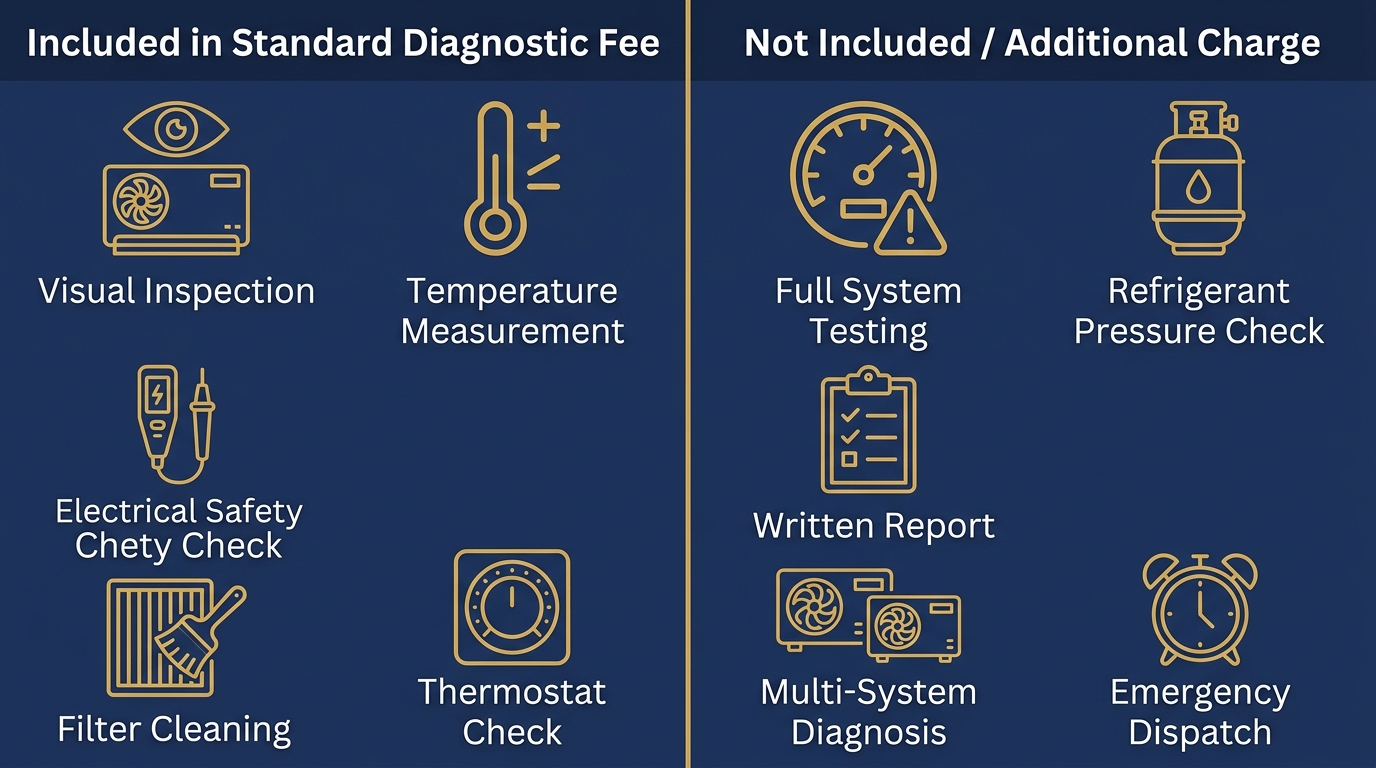
Standard HVAC diagnostic fee breakdown infographic
Understanding what your hvac diagnostic fee covers helps you make informed decisions when your system isn’t performing as expected. At Culver City Heating & Cooling Climate Control, we prioritize transparency so there are no surprises. In our next section, we discuss when it’s time to call for a diagnostic visit and what factors might affect the timeline.
Factors That Influence HVAC Diagnostic Fee Pricing
Understanding the factors that shape an hvac diagnostic fee can help homeowners in Culver City and the surrounding Los Angeles Area set realistic expectations before placing a service call. While the process of checking a system is fairly standardized, the final charge depends on when you need us, the policies of the company you choose, and how the diagnostic fee interacts with any needed repairs. Our customer-focused heating and air-conditioning company wants you to know what influences these costs so you can plan with confidence.
Standard vs. After-Hours Diagnostic Fees
The timing of your service request is one of the biggest drivers of cost. During regular business hours—typically 8 a.m. to 5 p.m.—our highly-trained technicians follow scheduled routes, and the operational overhead remains moderate. When you need emergency service outside those hours, however, the process changes. After-hours calls require immediate dispatch coordination, overtime labor, and a team member on standby, all of which increase the diagnostic charge. As our experience with urgent AC repair in Malibu shows, the same thorough inspection occurs, but the logistics of responding quickly mean that the service call fee will be higher. Homeowners can often minimize fees by scheduling non-urgent diagnostics during standard windows whenever possible.
Below is a qualitative overview of how the two service windows compare:
| Fee Characteristic | Standard Hours (8 a.m. – 5 p.m.) | After Hours / Emergency |
|---|---|---|
| Average Fee Range | Los Angeles: $75 – $150 | $150 – $300+ |
| Typical Appointment Window | Same-day or next-day, scheduled | Within 2–4 hours, unscheduled |
| Waiver Policy (if repair is approved) | Often waived for repairs over $200–$500 | Rarely waived; some companies credit toward repair |
| Typical Diagnostic Coverage | One system, basic visual and functional checks | Same coverage as standard + emergency dispatch coordination |
Keep in mind that every company sets its own policies, but this pattern holds true across the industry.
How Company Policies Affect Diagnostic Fee Waivers
Company policy is the single most direct factor in whether you will pay a diagnostic fee out of pocket. Some providers treat the inspection fee as a stand-alone charge, while others roll it into the cost of any subsequent repair. Many local providers, including our own HVAC maintenance inspections and air quality services in Studio City, structure their waivers around ongoing maintenance agreements. Homeowners who enroll in a preventive maintenance plan often benefit from waived or reduced diagnostic charges because the relationship shifts from a one-time transaction to a recurring partnership. In other cases, a diagnostic fee may be credited toward the repair only if the work meets a certain scope—something we clarify upfront so there are no surprises. Our highly-trained technicians are trained to explain these options clearly before any work begins, ensuring you understand exactly how the fee will be handled.
The Role of Diagnostic Fees in Overall Service Costs
A diagnostic fee is not an isolated expense; it is the gateway to a potential repair. When you receive an hvac diagnostic fee estimate, ask how it will be handled if repair work is approved. In many cases, the fee is deducted from the final bill if you choose to move forward with the recommended fix. If you decide not to proceed, the fee typically remains non-refundable, covering the technician’s time and expertise. Homeowners who have existing service agreements or maintenance plans may find that diagnostic fees are combined or waived entirely, making it worthwhile to inquire about bundling options. By viewing the diagnostic charge as part of the total job cost rather than a separate line item, you can negotiate more effectively and avoid paying for the same inspection twice.
Understanding how timing, company policies, and the total job scope influence the diagnostic fee gives you a clearer financial picture. When you schedule with a transparent provider like us, you can avoid unexpected costs and move forward with the confidence that your system will be diagnosed accurately and fairly.
Getting the Most from Your HVAC Diagnostic Visit
Once you’ve booked a professional diagnostic visit with us, you can take a few simple steps to make the appointment as productive and thorough as possible. Understanding what to expect and how to communicate effectively with your technician helps us identify issues faster and lays the groundwork for a straightforward repair recommendation.
The following strategies can help you maximize the efficiency of your diagnostic appointment.
| Approach | How It Works | Pros | Cons |
|---|---|---|---|
| Ask for a Fee Waiver if Repair Is Approved | Confirm upfront that the diagnostic fee will be credited toward the repair cost if you authorize the work. | Saves money if repair is needed; aligns with many company policies. | Not all companies offer this; must ask before service. |
| Schedule During Regular Business Hours | Book the diagnostic appointment between 8 a.m. and 5 p.m. on weekdays. | Avoids higher after-hour fees; more likely to get same standard fee. | May not be feasible for urgent breakdowns outside business hours. |
| Obtain a Phone or Virtual Estimate First | Describe symptoms clearly to the dispatcher; some companies provide a rough estimate without a truck roll. | Zero upfront cost; narrows down possible issues before the visit. | Less accurate than an on-site diagnostic; many issues require physical inspection. |
By choosing the approach that fits your situation, you help us deliver a focused diagnostic while maintaining a smooth experience from initial contact through final repair.
Questions to Ask Before Scheduling Your Diagnostic Visit
- Ask what specific components the technician will inspect—will they check the thermostat, electrical connections, refrigerant levels, and airflow?
- Inquire whether the diagnostic includes testing of both the heating and cooling functions if your system is a heat pump.
- Request that the visit summary be provided in writing, including a list of any identified faults and the recommended service steps.
- Confirm the estimated duration of the appointment so you can plan accordingly.
- Ask how you should prepare the area: clear debris, unlock gates, and secure pets so the technician can work safely.
How to Get a Preliminary Assessment Without an On-Site Visit
Sometimes you may want a rough idea of what’s going on before committing to a full on-site diagnostic. By calling us and describing your system’s behavior in detail—such as unusual sounds, inconsistent temperatures, short cycling, or error codes—we can often suggest likely issues and advise on the urgency of the situation. While this phone or video consultation cannot replace a thorough physical inspection, it gives you enough insight to decide whether to schedule a same-day visit or to monitor the situation. For instance, a thermostat that has become unresponsive might simply require a quick calibration, whereas a grinding noise could indicate a more serious mechanical concern that demands immediate attention. Our team’s capability to offer same-day thermostat diagnosis in Eagle Rock demonstrates our commitment to rapid, accurate preliminary assessments.
What to Expect During the Diagnostic Process
- Arrival and introduction: Our technician arrives at the scheduled window, introduces themselves, and briefly reviews the concerns you described.
- Safety check: Before any hands-on work, we verify that the equipment is powered down and that the work area is safe.
- Visual inspection: We examine the outdoor condenser unit, indoor air handler, ductwork, thermostat, and all accessible wiring, looking for signs of wear, leaks, or damage.
- Operational tests: We power on the system and monitor its performance—checking start-up, run cycles, temperature differentials, and electrical readings.
- Diagnostic tools: Using calibrated instruments, our NATE-certified technician measures refrigerant pressures, airflow rates, and electrical voltage to pinpoint anomalies.
- Findings discussion: Once testing is complete, we summarize our observations in plain language, showing you any faulty components and explaining the repair or maintenance needed.
- Written report: You receive a written summary of the findings, which you can review at your convenience and use to make an informed decision about next steps.
By understanding the diagnostic process and preparing in advance, you help our team work efficiently and accurately, which shortens the time from diagnosis to resolution. For ongoing maintenance or additional HVAC needs, explore our affordable HVAC services in Los Angeles. Whether you need a seasonal tune-up or a major repair, we’re here to keep your system running at peak performance. Trademarks remain owned by their respective owners. Brand names are referenced for identification purposes only and do not imply endorsement.
Understanding Diagnostic Fee Structures for Informed Decisions
Once you understand what a diagnostic fee covers, the next step is recognizing the fee structures you’ll encounter. In Los Angeles, HVAC service providers typically use one of two pricing models: a flat-rate diagnostic fee or an hourly diagnostic charge. Understanding these hvac diagnostic fee options helps you anticipate costs and choose a service that fits your budget. Our team at Culver City Heating & Cooling Climate Control believes that informed homeowners make the best decisions about their home comfort.
The table below compares the two most common diagnostic fee models.
| Pricing Model | Typical Fee Range (Los Angeles) | Transparency | Best For |
|---|---|---|---|
| Flat-Rate Diagnostic | $75 – $150 per visit | High — fixed price, no surprises | Homeowners who want cost certainty before the technician arrives |
| Hourly Diagnostic (Time & Materials) | $100 – $200 per hour (may include minimum 1-hour charge) | Moderate — depends on technician speed and complexity | Complex systems or multiple units where diagnostics may take longer |
The hvac diagnostic fee model you select influences how predictable your costs will be. A flat-rate diagnostic fee provides high transparency because you know the exact cost before the technician arrives, regardless of how long the diagnosis takes. This structure is ideal for straightforward issues like a capacitor failure or a simple refrigerant leak. In contrast, an hourly diagnostic model may be more cost-effective for quick fixes but can become expensive if troubleshooting extends into additional hours. In the Los Angeles area, typical flat-rate fees range from $75 to $150, and hourly fees from $100 to $200 per hour, according to market surveys. It’s also a common practice for companies to credit the diagnostic fee toward repairs if you hire them for the subsequent work.
Which model works best depends on your system’s complexity and your tolerance for uncertainty. A flat-rate fee suits homeowners who want a fixed, predictable cost, making it easier to budget for a diagnostic visit. Hourly billing, on the other hand, offers flexibility and can be a better value for complex systems with multiple zones where a technician may need extra time to trace the fault. However, you should always ask about potential additional charges, such as travel fees, after-hours surcharges, or separate fees for multiple units.
Before scheduling a diagnostic visit, we recommend asking the provider which fee model they use and whether the diagnostic fee is refundable or waived with repair. Fee structures can vary by market, but the concepts remain the same. Homeowners looking for HVAC services in Columbus, Ohio will find similar pricing models on our partner site. Knowing these fee models prepares you to ask the right questions and make a confident decision that protects your budget.
HVAC Diagnostic Fee Questions Answered
One common question about the HVAC diagnostic fee in Culver City is what it includes. Our diagnostic fee covers a thorough inspection of your system by a trained technician, assessing thermostat calibration, refrigerant levels, electrical connections, airflow, and safety controls.
We charge this fee because it ensures a comprehensive evaluation rather than guesswork. It typically applies toward the repair cost if you proceed with our recommended service. Industry standards in the Los Angeles area reinforce that a methodical diagnostic prevents unnecessary part replacements and protects equipment longevity.
While our policy reflects best practices for Culver City and the Los Angeles area, those seeking HVAC services in Northern New Jersey can find similar professional standards through providers like Reiner AC.
Once we identify the issue, our technicians proceed with efficient, transparent repairs. For an honest, no-surprise evaluation, contact us to schedule your diagnostic today.
Making Informed Decisions About HVAC Diagnostic Services
Now that you know what an HVAC diagnostic involves, it’s time to choose a provider wisely. As a customer-focused heating and air-conditioning company with highly-trained technicians serving Culver City and the Los Angeles Area since 1998, we suggest focusing on these considerations:
- Verify that the technician holds NATE certification and has years of hands-on residential experience.
- Confirm the diagnostic includes a full system inspection (electrical, refrigerant, airflow) and a written report.
- Choose a locally based provider in Culver City offering flexible appointments and a hassle-free, corrective approach.
An informed decision lays the groundwork for reliable service.