
Table of Contents
- Choosing Between a Smart Thermostat and a Manual Model for Energy Savings
- How Smart, Manual, and Programmable Thermostats Differ
- Energy Savings and Cost Benefits of Smart Thermostats
- How Smart Thermostats Reduce Energy Usage Day to Day
- Is a Smart Thermostat Worth It for Your Home and HVAC System?
- Plan Your Smart Thermostat Upgrade in Culver City
Choosing Between a Smart Thermostat and a Manual Model for Energy Savings
Choosing between a smart thermostat vs manual for energy savings in Culver City comes down to balancing convenience with measurable efficiency gains. The average household in the U.S. spends more than $900 per year on heating and cooling, so the thermostat you select directly impacts your monthly energy bills. ENERGY STAR certified smart thermostats deliver verified savings of about 8 percent on heating and cooling costs, which translates to roughly $50 per year for the typical home. Manual models remain a practical, budget-friendly option for homeowners who prefer straightforward control without the added complexity of connectivity.
We talk to homeowners from Culver City to Los Angeles every day who are thinking about these options. If you’re more interested in remote access and automated learning, or if you simply like things that are simple and reliable, weighing those tradeoffs will help you make the best decision for your home and your wallet. Ultimately, whether you want to pay now or pay later is a balance between convenience and how easy something is to set up right away.
Key Takeaways
- To choose a thermostat, homeowners must understand how each works so they can choose one that fits their daily activities and preferences for comfort.
- When comparing a smart thermostat vs manual for energy savings, the data favors certification.
- Smart thermostats outperform manual and basic programmable models by adapting to real occupancy rather than rigid schedules.
- For Culver City homeowners, the question of smart versus manual thermostats for energy savings hinges on how much control you want over your heating and cooling costs.
How Smart, Manual, and Programmable Thermostats Differ
To choose a thermostat, homeowners must understand how each works so they can choose one that fits their daily activities and preferences for comfort. With manual thermostats, you must make frequent changes to adjust to your temperature settings. programmable thermostats set schedules to automatically change temperatures based on when people are in the house. In contrast, Smart thermostats use Wi-Fi and sensors to adapt to your heat and AC usage in real time, often without any manual programming.
Here is a comparison of the three types of thermostats on key operational features:
| Thermostat Type | How It Operates | Schedule Flexibility | Remote Control | Best Suited For |
|---|---|---|---|---|
| Manual | Requires manual temperature adjustments each time | None | None | Households with simple routines or infrequent changes |
| Programmable | Follows pre-set schedules programmed by the user | Fixed weekly programs | None | Homes with consistent daily routines |
| Smart | Adjusts automatically based on occupancy and learning algorithms | Adaptive and learned schedules with geofencing | Full smartphone access | Households with variable schedules or unpredictable routines |
For households with predictable daily patterns, a programmable thermostat often provides the right balance of automation and simplicity. In contrast, smart thermostats shine in homes where schedules fluctuate frequently, as their adaptive recovery and remote access features ensure comfort without constant oversight.
What Sets Smart Thermostats Apart from Manual Controls
The difference between smart and other thermostats is the ability to learn what the people in your house like and automatically change temperatures based on that information. Unlike a manual thermostat, which you have to change constantly, or a programmable thermostat that just follows a schedule, smart thermostats use occupancy sensors and geofencing to know if anyone is at home or not. This means they can turn the temperature up or down automatically as needed without wasting energy on rooms that have no one in them.
U.S. Department of Energy states that programmable and smart thermostats cut down on wasted energy because they are set to specific temperature settings based on how the home is being used, unlike manual controls that keep the temperature constant whether or not anyone is at home. For homeowners in Culver City and the surrounding Los Angeles area, that can translate into less money spent on utilities while still maintaining the desired comfort level.
Learning Algorithms, Adaptive Recovery, and Remote Access
A big part of the smart thermostat function is learning algorithms that look at patterns throughout the home over time. These algorithms will build schedules for you that are responsive to changes in your daily routines, like working late or going on vacation. Adaptive recovery technology helps refine the schedule even more by predicting how long it takes the home to reach your preferred temperature, allowing the HVAC to turn itself on when you need it without stressing your equipment too much.
Through remote access on smartphone apps, people can now control their home’s temperature settings regardless of whether they are at work, away for vacation, or simply out running errands. They can view their usage, change the temperature or be alerted when there’s a spike in energy use that may be abnormal.
Energy Savings and Cost Benefits of Smart Thermostats
When comparing a smart thermostat vs manual for energy savings, the data favors certification. ENERGY STAR-certified smart thermostats deliver verifiable reductions in heating and cooling runtime based on real-world field data from a large, randomized sample of U.S. homes. These savings are calculated independently by the U.S. Environmental Protection Agency, ensuring that the ENERGY STAR label represents genuine energy efficiency regardless of regional climate or household habits.
Why Smart Thermostats Are Considered More Energy-Efficient
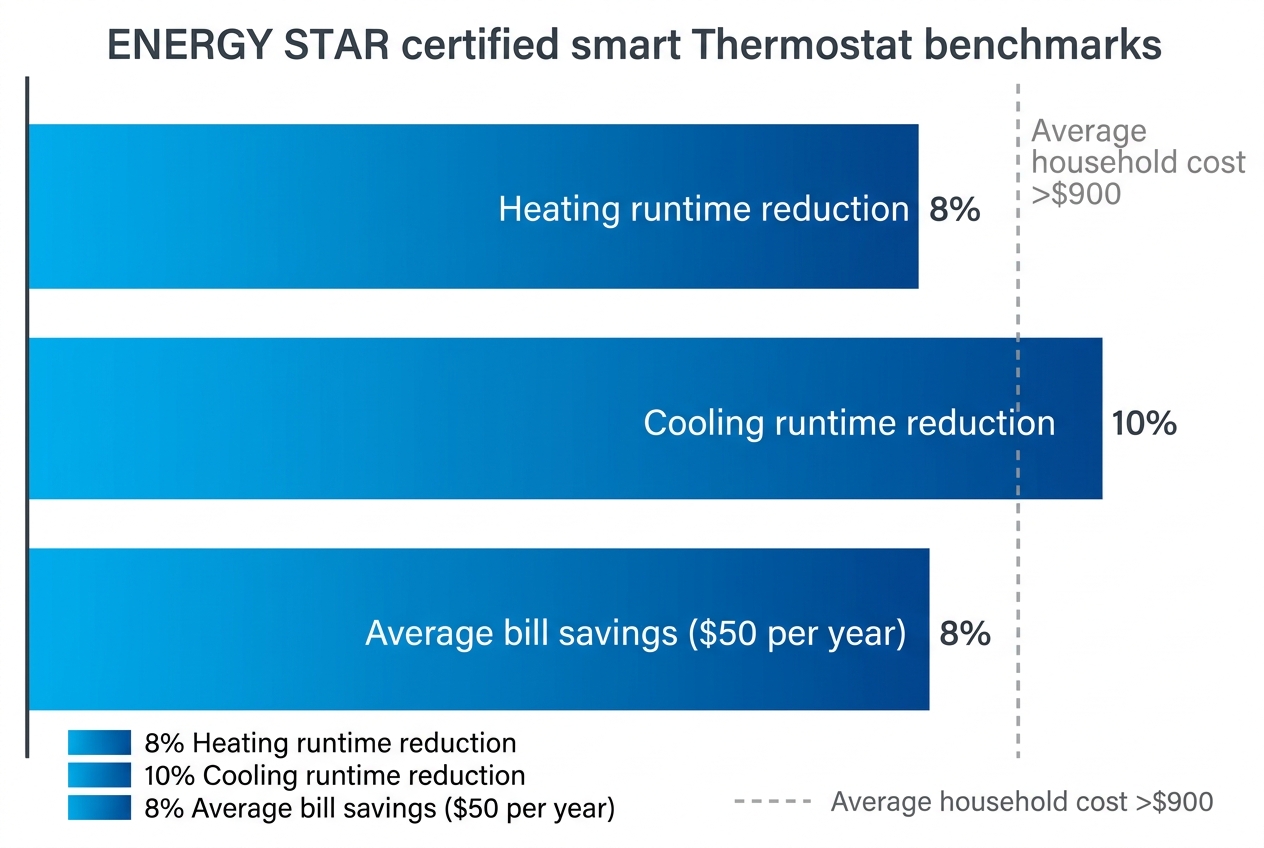
To be certified, smart thermostats must save at least 8 percent on annual heating run time and 10 percent on annual cooling run time compared to existing thermostats. The performance is verified through aggregated field data rather than laboratory estimates, and is designed to reflect actual energy usage patterns. Additionally, certified models must remain accurate within plus or minus 2.0°F, providing comfort without the waste of over-cycling.
These efficiencies are generated by new technologies such as learning algorithms that adapt to household routines, geofencing that adjusts temperatures when residents are away, and remote smartphone control for real-time adjustments. The EPA collects only aggregated scores from these devices, protecting individual customer usage data while validating the savings across diverse homes and climates.
How Much You Can Realistically Save on Energy Bills
The average American home spends nearly half its annual energy bill on heating and cooling, which can exceed $900 a year. ENERGY STAR® certified smart thermostats save around 8% on this bill and save roughly $50 a year for each certified model. These figures are weighted national averages based on verified performance data and may not match your individual experience if you have a different baseline usage, live in a different climate or your HVAC system is in poor shape.
In the case of utilities in Culver City, the potential for savings can become even more apparent. A household with unusually high heating and cooling bills would stand to benefit proportionately more, while those with more efficient systems could also see small yet significant savings. Certified units save consumers money through their daily activities, including automatic scheduling, participating in demand response and being continuously updated by new software to make efficiency algorithms more effective over time.
| Savings Metric | Certified Smart Thermostat Benchmark | What It Means for Your Bill |
|---|---|---|
| Heating runtime reduction | 8 percent | Less fuel burned for warmth |
| Cooling runtime reduction | 10 percent | Lower electricity demand for cooling |
| Average bill savings | ~8 percent (~$50 per year) | Direct reduction in energy costs |
| Average annual household cost | Over $900 | Context for savings magnitude |
These benchmarks show what you can expect from certified smart thermostats, but your actual savings will vary depending on how far behind you are today. If you have an old thermostat that runs too much, or has no controls at all, then the savings could be larger. However, if your equipment is well-maintained and doesn’t run that often, you might not see as great of a savings. Rebates and incentives may be available for certified models in the Los Angeles Area.
How Smart Thermostats Reduce Energy Usage Day to Day
Smart thermostats outperform manual and basic programmable models by adapting to real occupancy rather than rigid schedules. Unlike traditional thermostats that follow pre-set timers, certified smart models use occupancy-based learning to adjust temperatures efficiently, making manual programming optional for most households. This smart thermostat vs manual for energy savings advantage means your system works with your life instead of against it.
Do Smart Thermostats Actually Learn Your Schedule?
Smart thermostats, according to the U.S. Department of Energy, use adaptive recovery technology that analyzes historical use patterns and predicts when it needs to make adjustments in temperature for maximum comfort and energy efficiency. This learning mode means that it gets smarter and learns about your home’s schedule without you having to manually tweak settings. Users don’t program these devices with time-based schedules, but instead let the thermostat sense occupancy and automatically change the set points as necessary.
The system thus self-adjusts and calibrates over time to save on energy without losing comfort. This means that homeowners in Culver City and in the Los Angeles area may interact less often with their thermostat while the inside stays comfortable. The federal guidance stresses that this occupancy-based method is better than leaving a manually set thermostat at the same setting all the time, as this wastes energy by heating or cooling empty rooms. Smart thermostats give you access to your home’s energy usage from anywhere through your phone, and you can actually track how much energy you are using in real-time.
Cutting Energy Use While You Are Away from Home
Smart thermostats reduce energy waste while a house is unoccupied using geofencing technology and remote smartphone control, as well as programmed setbacks. Geofencing technology detects when people leave the house perimeter and puts the smart thermostat into a power-saving mode. Meanwhile, smartphones allow users to monitor and adjust the system remotely in real time, allowing them to verify setpoints or override any existing schedule from anywhere.
This means that these features reduce the demand on furnaces, heat pumps, and central air systems because temperatures are in sync with the occupants. Field testing shows that certified smart thermostats, proven through field testing, deliver significant energy savings by working with HVAC equipment when no one is home. For homes in Southern California, where heating and cooling account for nearly half of energy bills, these automated behaviors can result in real money savings, while still keeping homeowners comfortable.
In short, the magic of smart thermostats is in their daily automation, which sets them apart from both manual and basic programmable thermostats.
Is a Smart Thermostat Worth It for Your Home and HVAC System in Culver City, CA?
For Culver City homeowners, the question of smart versus manual thermostats for energy savings hinges on how much control you want over your heating and cooling costs. The average U.S. household spends over $900 annually on heating and cooling, nearly half of the total energy bill. ENERGY STAR certified smart thermostats deliver independently verified savings by learning your patterns and adjusting temperatures automatically, making them a compelling upgrade for many homes.
Worth the Investment with a Simple, Consistent Routine?
The traditional daily routine often benefits from a programmable thermostat that sets temperature settings on a schedule. Smart models add value by using occupancy-based adjustments—like geofencing to lower temperatures when you leave or adaptive recovery to pre-condition your home efficiently. These features reduce unnecessary HVAC runtime without needing to adjust anything manually.
The table below compares key decision factors to help you determine if a smart thermostat is right for your home:
| Decision Factor | Manual or Programmable May Suffice | Smart Thermostat Adds Value |
|---|---|---|
| Schedule predictability | Consistent routine with fixed hours | Variable routines benefit from automation |
| Occupancy patterns | Home most of the day | Frequent absences or travel |
| Remote access needs | Rarely needed | Travel or smartphone control required |
| Savings verification | Limited tracking | Real-time energy tracking via app |
| System compatibility | Standard wiring and basic setup | Wi-Fi connectivity and advanced features |
If your home fits the right column, the upgrade can deliver measurable efficiency gains and convenience. We recommend having one of our highly-trained technicians assess your system’s compatibility before purchasing.
Compatibility with Furnaces, Heat Pumps, and Central Air Systems
Our techs will check your thermostat’s wiring, system type, and whether or not it has Wi-Fi during in-home service visits to Culver City. No matter if you have a furnace, heat pump, or central AC system, we’ll make sure that the new one works smoothly with everything else. Your system’s compatibility and how far away it is from your router play an important role in how well it’ll work.
Rebates and incentives may be available for certified models in your area. Then, contact us to schedule a hassle-free and enjoyable compatibility assessment—we’ll help you choose the right thermostat for your home and climate goals.
Frequently Asked Questions
Why are Smart Thermostats Considered More Energy-efficient than Manual or Standard Programmable Models?
Smart thermostats are considered more energy-efficient because certified models must save at least 8 percent on annual heating runtime and 10 percent on annual cooling runtime compared to existing thermostats. These savings are verified through real-world field data rather than laboratory estimates.
Do smart thermostats actually learn my schedule or do I still need to program them manually?
Smart thermostats use adaptive recovery technology that analyzes historical use patterns and predicts adjustments without manual programming. They learn occupancy and adjust temperatures automatically, making manual schedules optional.
Is a smart thermostat worth the investment if I have a simple consistent daily routine?
A smart thermostat can still add value even with a simple routine by using occupancy-based adjustments like geofencing to lower temperatures when you leave. This reduces unnecessary HVAC runtime without manual changes.
How Much can I Realistically Save on Energy Bills by Switching from a Manual to a Smart Thermostat?
Certified smart thermostats save around 8 percent on heating and cooling bills, roughly $50 per year for the average U.S. household. Savings vary based on baseline usage, climate, and HVAC system condition.
Plan Your Smart Thermostat Upgrade in Culver City
If you compare a smart thermostat to a manual model in terms of saving energy, certified smart thermostats provide independent test results showing you’ll save about 8% on heating and cooling bills, or around $50 per year on average, according to real world field data from the certification program. Those savings result from features like geofencing, scheduling, and remote access from a smartphone that adjust automatically to your habits without having to constantly tweak settings manually. smart thermostat vs. a manual one for energy savings
First, make sure that your HVAC system can accept smart controls, and that your home has a good Wi-Fi signal. Use the ENERGY STAR rebate finder to find local utility incentives for certified models. By following these simple steps, you can choose a solution that will fit your home while also making both you and your system more comfortable and efficient.
Our crew can help you out with professional installation and flawless integration in your Culver City home. Call us at (424) 543-6788 or visit our website to book your upgrade now.
All trademarks are owned by their respective owners. Brand names are mentioned for identification purposes only and do not imply endorsement or affiliation.
Copyright 2026 © Culver City Heating & Cooling Climate Control.
Plan Your Thermostat Upgrade
You have now compared smart, manual, and programmable thermostats and seen how certified smart models deliver verified savings of roughly 8 percent on heating and cooling bills. Before purchasing, it is wise to confirm that your furnace, heat pump, or central air system and Wi-Fi setup can support the upgrade. A professional compatibility evaluation takes the guesswork out of wiring and system checks. At Culver City Heating & Cooling Climate Control, our trained technicians have served homes in the Los Angeles Area since 1998. We can assess your equipment and offer recommendations tailored to your household routine. You can also explore local utility incentives using a rebate finder for certified models. To get started, call us at (424) 543-6788 or request a quote online.