
Table of Contents
- Finding the Best 110 Volt Mini Split for Your Home Office or Small Room
- Understanding 110 Volt Mini Split Systems
- 110 Volt vs. 230 Volt Mini Splits: Efficiency and Capacity Compared
- Electrical and Installation Requirements for a 110 Volt Mini Split
- Rebates, Refrigerant Standards, and Long-Term Efficiency
- Frequently Asked Questions About 110 Volt Mini Splits
- Schedule Your 110 Volt Mini Split Evaluation with Culver City Heating & Cooling Climate Control
Finding the Best 110 Volt Mini Split for Your Home Office or Small Room
The best 110 volt mini split for your home office or small room is the one sized precisely to the room’s load and conditions. A properly matched unit runs efficiently without straining the compressor or short cycling, ensuring steady comfort and lower energy bills. Choosing a system based on square footage alone risks performance issues, so professional assessment is the smart first step.
The correct size is much more important than anything else. An undersize air handler will stay in maximum mode all day, stressing the compressor and not being able to cool down when it’s hot outside. Over-sized equipment short cycles, won’t remove moisture from the house correctly, and wears the unit down quicker. Professional Manual J load calculations account for ceiling height, insulation, windows, and local climate. They make sure the unit matches the room’s true needs, rather than relying on a rough estimate.
With over 28 years of experience serving Culver City and the Los Angeles area, we help homeowners select ductless systems that deliver reliable comfort without unnecessary complexity. Our technicians perform on-site evaluations to determine the right capacity and configuration for your space.
It’s going to help you understand which system should be used in certain situations and that will also pave the way for the remainder of this guide.
Key Takeaways
- Choosing a model is one step, the other is figuring out how big that model needs to be.
- After the electrical requirements and placement are settled, homeowners in Culver City naturally ask whether a higher-efficiency unit will pay off over time.
- Is it better to undersize or oversize a mini split?
Understanding 110 Volt Mini Split Systems
Choosing a model is one step, the other is figuring out how big that model needs to be. An example would be a 110v mini split unit, which can cool small rooms quite effectively because it doesn’t have enough power available from a low-voltage source to cool anything larger. So if you need this kind of device in your home, don’t expect it will cool down huge areas – they’re perfect for small bedrooms or office spaces as long as precision temperature control means more to you than actual power output.
Why Sizing Matters
Oversized and undersized units create different sorts of problems which reduce both comfort and efficiency. If a unit is too big for its space, it will run in short bursts to achieve the thermostat setting, and it won’t get rid of sufficient moisture from the air, making spaces feel damp and boosting the likelihood of mould spores. It can also overload some internal mechanical components, reducing their life expectancy. Conversely, if a unit is undersized, it’ll continue working to produce as much heat as possible, which stresses the compressor and fan motor into an early grave, while driving up electricity bills. short cycles
Typical sizes of 110V mini-splits vary by floor area and ceiling height. This data should be used as guidelines rather than strict regulations as the actual dimensions needed might change depending on the wall insulation quality, amount of open windows, and climatic condition where you live.
| Room Size | Ceiling Height Factor | Typical BTU Range | Sizing Risk to Avoid |
|---|---|---|---|
| Small bedroom or office (100–200 sq ft) | Standard 8 ft ceilings | 6,000–9,000 BTU | Short cycling or continuous running |
These representative ranges help narrow your options, but they’re not a substitute for a professional assessment. A Manual J load calculation considers all the variables that affect a space’s cooling needs, from insulation R-values to local weather patterns. Our technicians use this data-driven approach to recommend systems that deliver consistent comfort without unnecessary wear.
The inverter allows more flexibility by letting the compressor adjust its power consumption as needed, but that still isn’t enough to determine the size. Now that we’ve discussed how this works, the question becomes whether a 110V system provides adequate cooling, or if a 230V model will be better-suited for a particular application.
110 Volt vs. 230 Volt Mini Splits: Efficiency and Capacity Compared
The choice between a 110-volt unit or a 230-volt one mainly depends on the size of the place that needs to be conditioned and how it is being built. Modern invertor driven units at 110 volts can deliver efficiency ratings that rival larger 230v units, while capacity limits remain tied to the voltage ceiling of a normal household circuit. All this means choosing the right machine depends on a clear understanding of the room’s load.
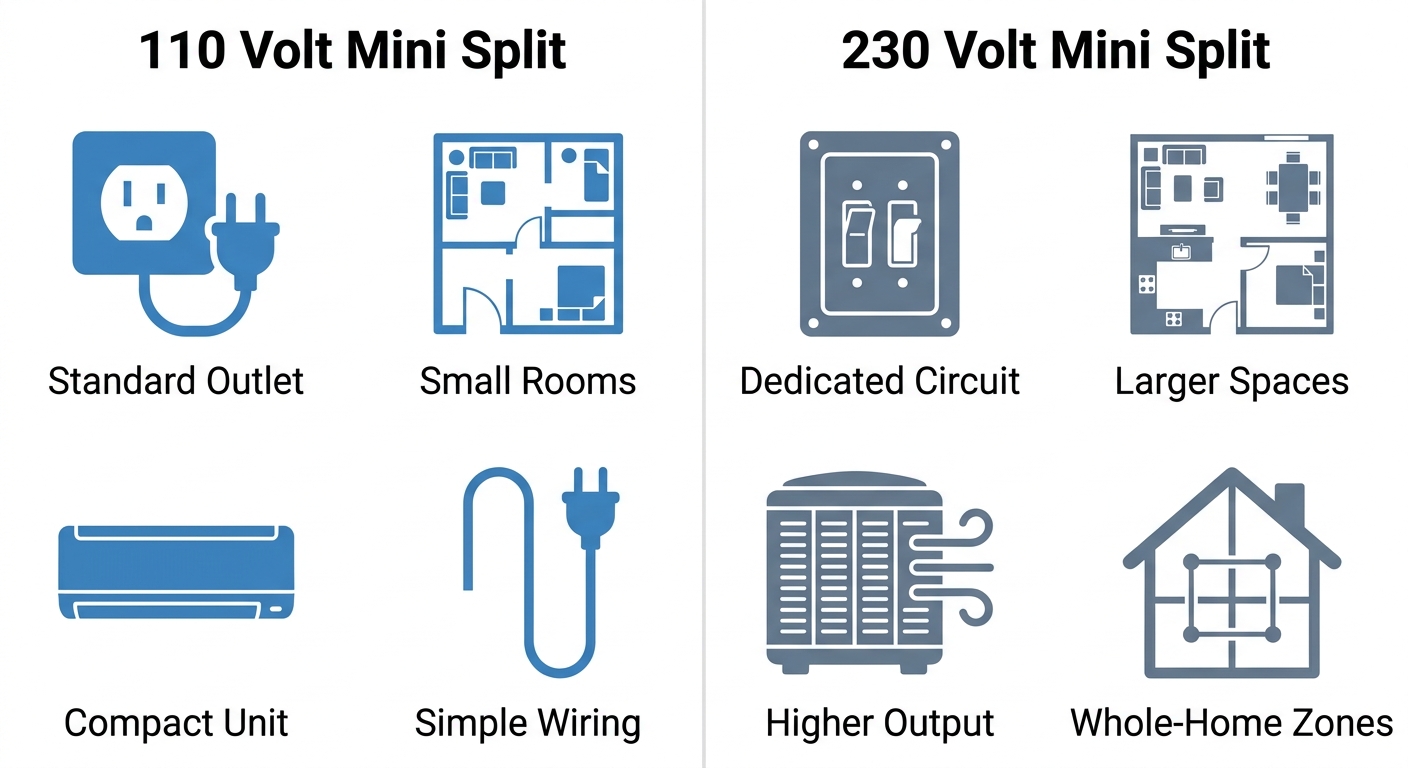
| Factor | 110 Volt Mini Split | 230 Volt Mini Split | What It Means for Your Decision |
|---|---|---|---|
| Power source | Standard household 110–120V circuit | Dedicated 230V circuit | 110V fits existing wiring; 230V needs new wiring |
| Typical capacity range | Smaller rooms / lower BTU ceiling | Larger spaces / higher BTU output | Voltage choice follows calculated load, not preference |
| Efficiency | Inverter 110V units approach 230V SEER2 performance | Standard SEER2 ratings | Both can reach SEER2 20–38 when properly sized |
| Best fit | Small rooms with modest calculated loads | Whole-home or large-zone conditioning | Match voltage to the space, not to a generic ‘better’ label |
Because ductless designs avoid the energy losses of ductwork, mini-split systems routinely post SEER2 ratings between 20 and 38, regardless of whether they run on 110 volts or 230 volts. What changes with voltage is the maximum capacity the system can safely deliver on a single circuit. A 110 volt mini split is engineered for smaller rooms where the calculated load fits within the limits of a standard outlet, while a 230 volt unit steps up to handle larger zones or whole-house applications that exceed those limits.
Are 110 Volt Mini Splits as Efficient as 230V Systems?
Systems are sized based on Manual J calculations to ensure that the proper amount of capacity is matched to each individual room’s heat and/or cooling requirements. Oversize equipment short-cycles, which does not allow enough time for humid air to be removed from the home nor does it protect components as they cycle on-and-off rapidly. Undersized equipment will run continuously at maximum output. Inverter Technology changes the game since compressors can vary the output in these low-voltage applications, offering improved part-load efficiency and dehumidification. Ductless systems have the added benefit of avoiding the ductwork losses. Both voltage classes reach SEER2 ratings between 20 and 38. When properly sized, there can be energy-efficiency parity achieved at 110 volts.
Maximum BTU Capacity: Where the Voltage Ceiling Sits
The practical upper limit for 110 volt equipment is set by the circuit’s amperage and the unit’s internal design. A correctly sized 110 volt mini split can comfortably handle modest loads in small rooms, but pushing beyond its engineered capacity risks tripping breakers or reducing equipment life. We use Manual J calculations—accounting for ceiling height, insulation R-values, window exposure, and local climate—to determine the exact BTU requirement before selecting voltage.
Why Inverter Technology Changes the 110V Equation
These variable speed inverter compressors will enable the 110volt mini splits to run much slower for longer periods on low output settings saving energy as well as helping to dehumidify spaces better and keeping people in the room more comfortable.
Electrical and Installation Requirements for a 110 Volt Mini Split
Now that you have a 110 volt mini split at home, make sure that everything will be connected properly to prevent problems with electricity. Make sure that your electrician does the proper installation to ensure safety and efficiency, prevent nuisance tripping, and protect equipment lifespan.
Can a 110 Volt Mini Split Be Plugged into a Standard Wall Outlet?
The 110-volt mini-split can be plugged in to your typical wall socket, provided that the manufacturer of the system has specifically authorized that model to work this way. The specifications included at the base of the equipment should govern what you can connect it up to, not your imagination as to whether or not some outlets will work better than others. Even though there might be room to connect a small machine through any outlet, our people check to make certain the circuitry can handle the power demands of your unit before we put it all together on site. Otherwise you’re running the risk that it may overload and burn itself out. And since the compressor turns on and off again quite often, this danger looms even more strongly. only if the manufacturer’s specifications explicitly allow it for that specific unit amp draw rating
Many installations still benefit from a hardwired connection or professional check out, even though an electrical socket is technically an option. A certified technician will analyze your home wiring, outlet condition, and local regulations to determine whether a plug-in is permitted or whether a dedicated circuit or hardwired connection is safer.
Do You Need a Dedicated Circuit for a 110V Mini Split System?
Sharing a circuit with other loads—like lighting or appliances—can lead to nuisance breaker trips when the mini split’s compressor cycles on. This happens because the sudden amp draw from the compressor exceeds the shared circuit’s capacity, even if the breaker isn’t technically overloaded. Local electrical codes and the manufacturer’s installation manual often recommend a dedicated circuit to avoid these interruptions and protect the system’s performance.
There isn’t one universal answer: your home’s electrical rules and the manufacturer’s requirements determine whether a dedicated circuit is needed, and an electrician’s assessment clarifies what the existing wiring can safely support. Our technicians carry out that evaluation as part of a thorough on-site assessment, ensuring the system operates within safe parameters from day one.
The Value of Professional Sizing and On-Site Evaluation
A professional evaluation in Culver City or the Los Angeles Area begins with a Manual J load calculation, which accounts for ceiling height, insulation R-values, window exposure, and local climate data. This step ensures the 110 volt mini split is sized correctly—not oversized or undersized—so it runs efficiently without straining the compressor or leaving humidity issues unaddressed. Even inverter-equipped units require accurate initial sizing to deliver long-term comfort and efficiency.
When they come in-person for an assessment, our technicians verify electrical compatibility, determine optimal mounting locations, and provide written estimates that outline the installation scope and equipment selection. As a result, this hands-on approach protects your investment by preventing short cycling, excessive wear, and premature failure—issues that often arise from DIY sizing or generic square-footage estimates.
When looking to pick out a 110 volt mini split, you need to be aware about how much power it requires. With our help we’ll turn those specs into a working system, positioning the unit to deliver reliable comfort and energy savings for years to come.
Rebates, Refrigerant Standards, and Long-Term Efficiency
After the electrical requirements and placement are settled, homeowners in Culver City naturally ask whether a higher-efficiency unit will pay off over time. That’s why we focus on rebate eligibility and refrigerant standards—because the right system can deliver both immediate savings and lasting comfort.
Ductless mini-splits qualify for higher per-ton rebates through LADWP’s tiered program because they avoid the energy losses common in ductwork. Even a modest 0.5–1.0 SEER2 improvement can shift equipment into a more lucrative incentive tier. Look for systems with SEER2 ratings of 20–38 and HSPF2 ratings of 10–14, which exceed traditional central systems and meet the strict requirements verified through the AHRI directory. With the 2025 California Energy Code taking full effect in January 2026, choosing a high-efficiency heat pump now aligns with the latest standards and maximizes your rebate potential. These systems also often qualify as the best 110 volt mini split options when paired with local rebate programs.
The refrigerant transition also matters. Newer systems use R-454B, a low-GWP refrigerant with a global warming potential of 466—far below the 2,088 of older R-410A. These systems cannot be retrofitted, and because R-454B is classified as A2L, certified technicians are required for safe installation. The good news? High-efficiency variable-speed models deliver superior dehumidification and comfort, making them ideal for Culver City’s coastal climate.
Stacking incentives can further reduce your net cost. The 30% federal 25C tax credit can be combined with LADWP rebates, and we help our Culver City neighbors navigate the paperwork with a spirit of hassle-free and enjoyable service. Before you decide, confirm your eligibility and review current program terms—we’re here to guide you every step of the way.
Frequently Asked Questions About 110 Volt Mini Splits
Is it better to undersize or oversize a mini split? Neither option is ideal—oversized units short cycle and fail to dehumidify properly, while undersized systems run continuously and stress the compressor.
What size should be used in the space I rent out? We recommend having a Manual J load calculation performed, which takes into account ceiling height, insulation R-value, windows, and weather. The correct BTUs will vary according to your needs.
Do ductless mini splits qualify for higher rebate rates? Yes. Because they eliminate ductwork, these systems often qualify for higher per-ton rebates through programs like LADWP, especially when SEER2 ratings reach 20–38 and HSPF2 ratings hit 10–14.
Before purchasing any system, contact our professionals who will verify your equipment’s eligibility through the AHRI directory to ensure rebate compliance and long-term performance in your Culver City home.
Frequently Asked Questions About 110 Volt Mini Splits
What is the maximum BTU capacity available for a 110V mini split?
A 110V mini split’s maximum capacity is limited by the circuit’s amperage and the unit’s design. These systems are engineered for smaller rooms, typically ranging from 6,000 to 9,000 BTU for spaces like small bedrooms or home offices.
What are the benefits of choosing a 110V mini split for a home office or small room?
A 110V mini split delivers precise temperature control for small spaces without the energy losses of ductwork. Inverter technology allows efficient, quiet operation and better humidity control, making it ideal for focused work areas.
Do I Need a Dedicated Circuit for a 110v Mini Split System?
A dedicated circuit is often recommended to prevent nuisance breaker trips caused by the compressor’s startup load. Whether it’s required depends on local electrical codes and the manufacturer’s installation manual, so an electrician’s assessment is needed.
Schedule Your 110 Volt Mini Split Evaluation with Culver City Heating & Cooling Climate Control
After going over what you need we would say that the best 110 volt mini split for your home in Culver City should be evaluated properly because only then will we make sure the best recommendation possible for you. Our qualified specialists ensure this unit is up to the 2026 efficiency standards and all local rebates criteria.
We’ll visit your location, assess your space, and guide you through available incentives so you can enjoy year-round comfort without guesswork. Call us up now at (424) 543-6788* or send an e-mail to admin@culver-city-heating-cooling-climate-control.com to schedule your evaluation today.
© 2026 Culver City Heating & Cooling Climate Control
Schedule Your Mini Split Evaluation
Choosing the right 110 volt mini split comes down to matching the unit to your room’s actual load, which is exactly what a professional evaluation confirms. Our technicians perform Manual J load calculations that account for ceiling height, insulation, windows, and local climate in Culver City, California. With the sizing and efficiency insights from this guide, you now know what to look for in equipment ratings and rebate eligibility. Since 1998, our certified team has helped homeowners throughout the Los Angeles Area turn careful research into comfortable, efficient homes. A single on-site visit covers the load calculation, electrical verification, and equipment selection guidance, along with a written estimate. Call us at (424) 543-6788 or email admin@culver-city-heating-cooling-climate-control.com to schedule your evaluation. Year-round comfort in your small space starts with one simple conversation.