

Table of Contents
- Getting the Right Mini‑Split Size for Your Home
- Why Getting the Right Mini‑Split Size Matters
- The Hidden Drawbacks of an Oversized Mini‑Split System
- Why Undersizing a Mini‑Split Leads to Discomfort and Higher Costs
- How a Professional Load Calculation Ensures Proper Sizing
- Inverter Technology and Its Impact on Sizing Flexibility
- Making the Right Choice for Your Home Comfort
Getting the Right Mini-Split Size for Your Home
When homeowners ask whether it is better to undersize or oversize a mini split, the short answer is that neither approach is ideal, correct sizing through a professional Manual J load calculation prevents the short cycling, constant running, and uneven temperatures both cause. Ceiling height directly increases the total air volume of a space, so taller garages or rooms often require higher BTU capacities to maintain even temperatures. At the same time, the quality of insulation matters: walls rated at R-13 and ceilings at R-19 reduce heat flow and can lower the HVAC load, allowing for a more modest unit size when the building envelope is thermally efficient. Skipping these variables frequently results in undersized units that run continuously without meeting set points, or oversized units that short cycle and waste energy. Getting the right size for your home prevents these issues and sets the stage for reliable comfort, making a professional assessment the essential first step.
Key Takeaways
- A mini-split’s performance, energy efficiency, and longevity all hinge on whether its BTU capacity matches the actual heating and cooling load of the space.
- Oversizing your mini-split system in the garage seems like a good idea, but there are actually many hidden performance and efficiency issues.
- Just as an oversized mini-split can start cycling on and off and waste energy, too little capacity can have its own complications.
- Manual J load calculation: what exactly does this mean?
- While inverter-driven units offer flexibility, correct sizing remains essential for comfort and efficiency.
Why Getting the Right Mini-Split Size Matters
A mini-split’s performance, energy efficiency, and longevity all hinge on whether its BTU capacity matches the actual heating and cooling load of the space. Homeowners often wonder whether it is better to undersize or oversize a mini-split, but the reality is that neither extreme works well.
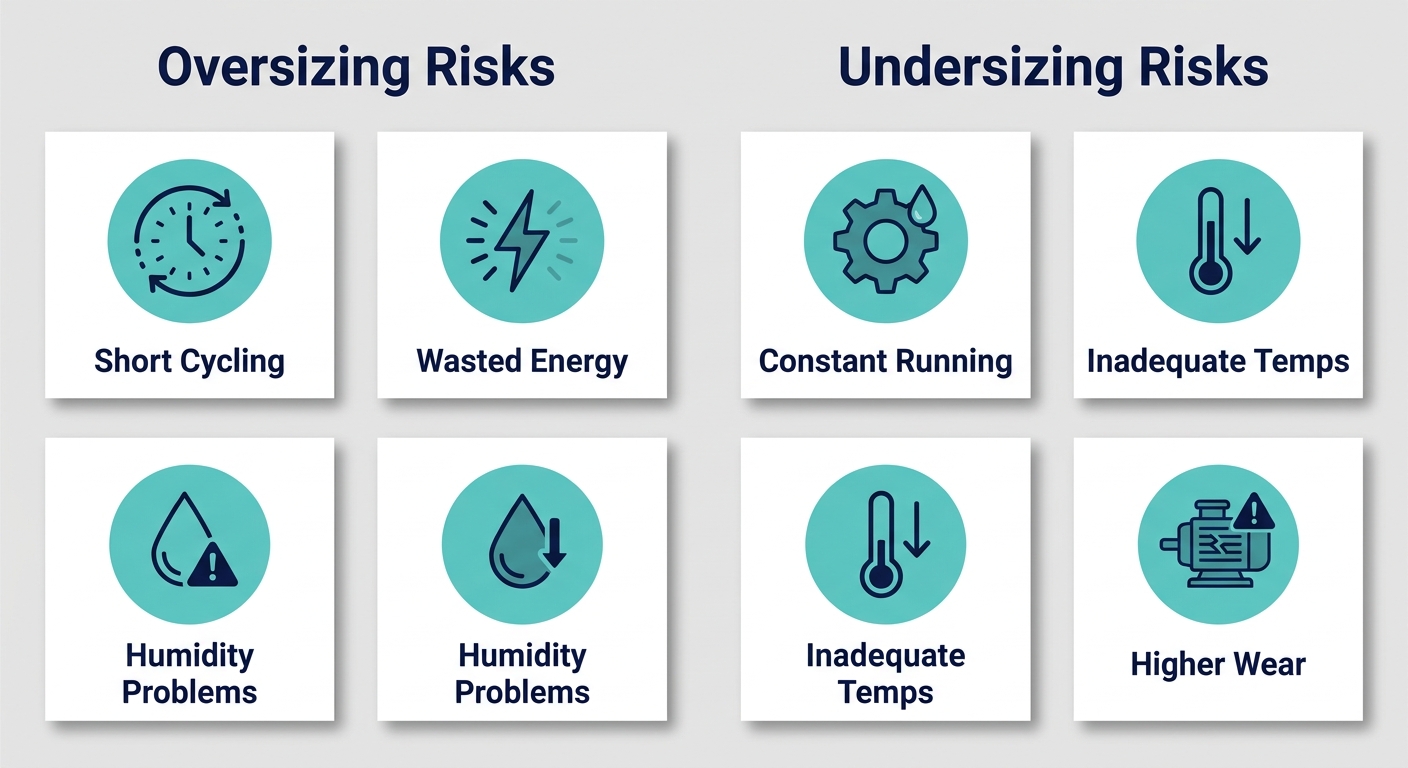
- Undersized units struggle to reach the set temperature on very hot or cold days. They run almost continuously, pushing energy bills higher and accelerating wear on the compressor and fans.
- Oversized units short-cycle—turning on and off frequently—which prevents the system from running long enough to dehumidify properly, creates uncomfortable temperature swings, and stresses electrical components.
In short, since short cycling produces sudden, intense bursts of cool air, your room may feel comfortable at first, but the air stays moist and clammy. Constant high-humidity conditions can also encourage mould growth, while the repeated start-and-stop cycles reduce the unit’s overall lifespan.
That is precisely why sizing is not simply a matter of calculating square feet; you must take into account the other variables each room may have.
Ceiling height and insulation levels are two factors that directly affect the required BTU—and they’re often overlooked in quick online calculators. Ignoring that extra cubic space can leave you with an undersized unit that can’t keep up. Insulation, on the other hand, reduces the load. Higher R-values—such as R-13 in walls and R-19 in ceilings—slow down heat transfer, which means a correctly sized system can be smaller and still perform effectively. To avoid both extremes, a professional Manual J load calculation accounts for all these variables: room volume, insulation, window area, and even local climate data.
Both sides have drawbacks. Oversized units have hidden drawbacks, especially chronic humidity issues and short-cycling damage—that often catch homeowners off guard. Homeowners often believe that bigger is automatically better, but in truth an oversized HVAC system could end up just being more troublesome than useful.
The Hidden Drawbacks of an Oversized Mini-Split System
Oversizing your mini-split system in the garage seems like a good idea, but there are actually many hidden performance and efficiency issues. To help people understand why, if your mini split is oversized, you’ll face short cycling and energy waste.
Short cycling is the most common hidden drawback of an oversized system. Instead of running in steady, temperature-controlled cycles, the unit repeatedly turns on and off in short bursts. It cools the air so quickly that it never operates long enough to dehumidify the space or stabilize temperature evenly. As a result, the garage experiences abrupt temperature swings, stubborn humidity, and increased mechanical wear. Every rapid start-up stresses the compressor and electrical components, shortening the unit’s useful life while driving unnecessary energy consumption.
Oversizing often results from the “square foot rule.” While a square foot measurement provides information about interior floor area, it ignores the vertical dimension and the building envelope (insulation). A typical 24 x 24 garage will contain a certain amount of cubic air, but many have higher ceilings to allow extra storage. The greater the vertical height in the structure, the more BTU a unit must provide over what could be assumed from a floor area-based calculation. Also, when insulation in a wall, particularly in a ceiling, has low R-value, it allows either hot or cold air into the structure rapidly. If a square-footage based rating does not compensate for the loss, then the unit may actually be far too large, causing it to turn off and on excessively.
Our certified technicians rely on Manual J load calculations to eliminate guesswork and prevent these sizing mistakes. They take into account factors like ceiling height, the amount of insulating material used, location of windows, and weather patterns in your area. With decades of hands-on experience since 1998, we treat every Culver City and Los Angeles Area garage as a unique project, not a one-size-fits-all number. We won’t use numbers blindly and won’t install a larger system than needed if a smaller capacity model is sufficient. This means you get the right size unit without excessive wear and tear on your mechanical systems, which helps reduce energy costs.
The larger size leads to inefficiency and mechanical strain. Leaving a mini-split too small for the space produces an entirely different set of comfort challenges that deserve equal attention from a design perspective.
Why Undersizing a Mini-Split Leads to Discomfort and Higher Costs
Just as an oversized mini-split can start cycling on and off and waste energy, too little capacity can have its own complications. If the air conditioner is under-powered, the mini-split will operate all the time but still not be able to satisfy the demands made upon it by the thermostat. Your house may feel uncomfortable if this happens.
The smaller-sized model runs continuously all day long because it doesn’t have any choice but to run at maximum output to produce sufficient heat in cold weather or cold air in hot weather to cool off or warm up its area to meet your specified temperature. On scorching hot summer days or frigid winter nights, the interior conditions will stay many degrees from the target temperature, leaving the room useless for many hours until the room eventually reaches the desired temperature. The continuous running puts extra stress on the compressor and motor that drives the air delivery fan, causing additional frequent repairs, and decreasing the longevity of this system. It is deprived of those short breaks to allow for the proper refrigerant flow cycle and defrosting period if required.
If insulation on the walls and in the ceiling does not reach the required R-values (i.e., R-13 walls, R-19 ceiling), heat transfer increases and the performance gap of an undersized unit widens. In Culver City many of the garage units that have higher ceilings hold much more volume than the square footage used to determine the size of a mini-split system, according to our sizing guidelines. If there isn’t sufficient thermal resistance in this instance, the undersized unit struggles even more to maintain even indoor temperatures.
A small setup means poor humidity regulation as well. The compressor might run constantly yet still fail to remove enough moisture because the coil temperature stays too warm for effective dehumidification. In other words, you’ll have a clammy indoor climate that feels stickier in summer and can promote mold growth, even though the compressor is running constantly. The compressor and fans work without end and consume more energy than what was saved on a small unit in the first place.
In order not to undersize or oversize, we recommend a professional Manual J load calculation. We measure all of your room’s ceiling heights and account for insulation values, window exposure, and local climate, because when we size a system in Culver City we rely on Manual J to match the equipment to the actual heat loss and gain of your space, ensuring reliable comfort and efficient operation year-round, factors the shortcut square-footage method overlooks.
How a Professional Load Calculation Ensures Proper Sizing
Manual J load calculation: what exactly does this mean? Manual J determines your home’s heating/cooling requirements and dictates the size needed for mini-split systems. It is NOT determined using only room sizes. Our certified technicians in Culver City rely on Manual J to determine exactly how much you’ll need, because not all rooms have the same insulation values, window area, or ceiling height. This process also eliminates the common problem of having too much or too little heating/cooling capacity. It is the foundation of every professional mini-split installation we perform in the Los Angeles area.
Physical details such as ceiling height and insulation R-value directly affect the load result. A taller ceiling increases the volume of air to condition; a garage with an elevated ceiling in the Culver City area may need a higher BTU rating than a standard-height space of identical square footage. Our technical guidance for a 24-by-24-foot garage illustrates this: a base recommendation of about 24,000 BTUs would shift higher for a taller ceiling. Insulation reduces heat transfer, so walls at R-13 and a ceiling at R-19 can lower the required capacity, letting us select a smaller, more efficient unit. These variables, along with window placement and seasonal temperatures, are all part of a proper Manual J assessment that avoids generic sizing charts.
If done right, the load calculation will prevent your system from short-cycling, the poor pattern of many rapid on-off cycles that waste electricity and wear out components. A properly-sized mini-split will run more slowly but for much longer periods. This keeps rooms at a constant temperature while controlling moisture, thereby saving power too. So far as we’ve served Culver City’s owners here since 1998, it has lowered the number of return calls to help make systems work well over time. From here we take the data from the calculation and connect the house to a mini-split equipped with an inverter-controlled variable capacity drive. That drive enables it to change output in sync with what you require at any moment. Doing so allows us to install hassle-free and uniquely tailored to your spaces. short cycling
Inverter Technology and Its Impact on Sizing Flexibility
In addition, although a Manual J load calculation identifies the exact size requirements for your space, inverter-powered mini-splits provide an additional measure of forgiveness for slightly off sizes.
Inverter technology uses a variable-speed compressor that continuously adjusts its output rather than cycling on and off like a traditional single-stage unit. This modulation allows the system to run at partial capacity, maintaining steady temperatures without full-blast starts and using less electricity than a fixed-speed system would. As a result, a slightly oversized inverter unit will not short-cycle the way a fixed-speed system would; it simply throttles down to match the lower load. Similarly, a modestly undersized inverter system can run longer at its upper range to satisfy demand without sacrificing comfort. This directly addresses the common question of whether it is better to undersize or oversize a mini split—with an inverter, moderate mismatches in either direction are far less problematic than they would be with conventional equipment.
Our technicians in Culver City will employ this strategy to size a mini-split for a 24×24 garage according to our company’s internal FAQ, which states that tall ceilings increase total air volume, usually causing the required power rating to exceed the 24,000 BTUs needed to cool a standard garage height. However, sufficient insulation in the form of R-13 walls and an R-19 roof lowers the heat flow into the garage from outside, thus reducing the garage’s cooling load. Our techs include the added ceiling volume and the insulation’s R-value when calculating what size of an inverter unit we recommend, ensuring the inverter unit’s modulation range easily covers the garage’s actual thermal needs. Inverter technology shines here because it can handle the wider load swings that these physical variables create. When a home owner has high ceilings plus great insulating materials like R-13 walls and R-19 roof, the inverter can balance the effects of the extra cubic foot of air and improved thermal performance without either short cycling or operating all the time at full speed.
Learning more about inverter flexibility as it applies to actual house building techniques can help Culver City homeowners choose a garage climate solution that aligns with their long-term comfort goals. While professionals recommend calculating loads as the best starting point, knowing that the inverter will compensate for moderate sizing errors gives you confidence in achieving reliable, energy-efficient heating and cooling for your home.
Frequently Asked Questions
What are the consequences of oversizing a mini-split system in my home?
Oversizing a mini-split causes short cycling, wasted energy, and poor humidity control. The unit turns on and off frequently, creating abrupt temperature swings, leaving the air damp, and increasing mechanical wear that shortens the equipment’s useful life.
Why does an undersized mini-split struggle to maintain comfort in extreme weather?
An undersized mini-split runs continuously but still cannot reach the thermostat set point on extremely hot or cold days. It lacks the capacity to overcome severe outdoor temperatures, so the indoor space remains many degrees from the target level.
How does ‘short cycling’ affect the lifespan and efficiency of my HVAC equipment?
Short cycling stresses the compressor and electrical components with repeated start-ups, accelerating wear and reducing the system’s lifespan. The rapid on-off bursts also waste energy and prevent the steady operation needed for efficient performance.
Can a professional load calculation prevent the common mistakes of oversizing or undersizing?
Yes, a professional Manual J load calculation prevents oversizing and undersizing by evaluating ceiling height, insulation R-values, window area, and local climate. It determines the exact heating and cooling load to match equipment capacity precisely to the space.
Does modern inverter technology make it safer to slightly oversize a mini-split unit?
Yes, inverter technology allows a slightly oversized unit to modulate its output safely. An inverter-driven compressor runs at partial capacity and throttles down to match the actual load, avoiding the short cycling typical of fixed-speed systems.
Making the Right Choice for Your Home Comfort
While inverter-driven units offer flexibility, correct sizing remains essential for comfort and efficiency. Factors such as ceiling height and insulation levels affect the BTU capacity, and a professional load calculation prevents issues like short cycling that can compromise system longevity. This article has addressed the question of whether it is better to undersize or oversize a mini split by confirming that precise sizing is preferable to either extreme. Over 28 years of experience in Culver City has shown us that no amount of inverter adaptability can compensate for a unit that is too small or too large. We encourage you to connect with our certified technicians at Culver City Heating & Cooling Climate Control; we provide evaluations and guidance to help your home maintain comfort. Trademarks remain owned by their respective owners, and brand names are referenced for identification purposes only without implying endorsement or affiliation. Copyright 2026 © Culver City Heating & Cooling Climate Control.
Get Expert Mini-Split Sizing
You now know that correct mini-split sizing is critical to avoid short cycling and discomfort, and factors like ceiling height and insulation make a DIY guess risky. Our certified technicians use Manual J load calculations that account for your home’s unique characteristics. We have been providing reliable HVAC solutions in Culver City and the Los Angeles area since 1998. Even inverter-driven units benefit from proper initial sizing to operate at peak efficiency. Let us take the guesswork out of selecting the right capacity for your mini-split system. Call (424) 543-6788 to schedule a consultation with a local expert. Your comfort and long-term savings start with a professional assessment.