
Table of Contents
- Is It Better to Run a Mini Split on 110 or 220?
- How Voltage Affects Mini Split Operation
- Efficiency Showdown: 110V vs 220V Mini Split Performance
- Choosing Between 110V and 220V for Your Home Mini Split
- Wiring and Code Requirements for Mini Split Installations
- Common Questions About Mini Split Voltage Selection
- Making the Right Voltage Choice for Your Mini Split
Is It Better to Run a Mini Split on 110 or 220?
Deciding whether it is better to run a mini split on 110 or 220 depends on your home’s existing wiring and the unit’s cooling capacity. For most whole-room or multi-zone installations, a 220-volt connection delivers steadier efficiency and lower long-term operating cost, while a 110-volt unit simplifies installation where dedicated higher-voltage circuits are not already present.
To be sure, homeowners in Culver City and the Los Angeles area often weigh installation complexity against everyday energy performance. Voltage choice affects panel compatibility, compressor startup, and correct equipment sizing for air conditioning needs. When we come to your property in Culver City for a consultation, our technicians and sales engineers conduct an on-site evaluation to confirm panel capacity, circuit availability, and appropriate equipment sizing for your home’s cooling load.
Next we’ll review how all these voltages play into different wire sizes, their efficiency differences, and the real-world tradeoffs that come up when we’re doing installations and running our systems day-to-day. Once you understand the effects that voltage has on this stuff, you can decide which way makes more sense given what you have at your house.
Key Takeaways
- When comparing 120 volts versus 240 volts, the selected voltage determines a mini-split’s characteristics.
- When deciding whether it is better to run a mini split on 110 or 220, efficiency is a top concern for homeowners weighing their options for supplemental heating and cooling.
- If you’re in Culver City and have to choose between 110v or 220v, the decision starts with your panel capacity.
- The voltage you pick when setting up your mini split will influence the efficiency, heat pump size needed, and how simple installing it is, all things which we think about during each call.
- To answer whether it is better to run a mini split on 110 or 220, we carefully consider your Culver City home’s specific setup.
How Voltage Affects Mini Split Operation
When comparing 120 volts versus 240 volts, the selected voltage determines a mini-split’s characteristics. That said, as per the simple P = V × I equation for electrical power, there will be a smaller current if the power is delivered at a greater voltage. When there’s less current flowing through the wires, there is reduced resistive heat generated within those wires. This directly affects conductor size and required circuit breaker ratings.
If that current flows through a conductor made of copper it causes I²R heating. Doubling the voltage halves the current, cutting resistive power loss by roughly a factor of four. It’s true that there aren’t going to be massive savings in efficiency in a properly designed mini-split, but cutting wasted heat helps the system run cooler and can extend component life over many seasons. Big units that need much extra electricity to run compressors and fans lean on higher voltage to keep current within practical limits, allowing standard household wiring to carry the load safely.
For example, let’s examine how this works with some standard home setups for unit size, volts used, and electrical needs.
| Capacity (BTU) | Typical Voltage | Circuit Breaker Type | Common Applications |
|---|---|---|---|
| Standard Household Units | 120V | 15 A | Small rooms or supplemental cooling |
| Larger Units | 240V | 20 A | Whole-room or primary cooling |
If the system has greater capacity requirements, it moves to 240 volts to reduce the amperage sufficiently such that 12- or 14-gauge wiring and a standard 20-amp breaker handle the load without overheating. This keeps installation straightforward and helps the system operate consistently across summer afternoons when outdoor temperatures push the equipment harder.
Every mini split is engineered to operate at one specific voltage. Connecting a unit designed for 240V to a 120V circuit will starve the compressor and may cause permanent damage. Conversely, feeding 240V into a 120V-rated unit can destroy internal electronics instantly. Our highly-trained technicians always verify the nameplate rating before starting any installation, and they size wiring and breakers according to manufacturer specifications and local electrical codes. In Culver City and across the greater Los Angeles area, permit requirements and municipal amendments to the National Electrical Code can add specific rules that a qualified electrician should review.
Voltage-driven variations in current and power loss have a direct impact on electrical efficiency. Therefore, understanding how the voltage affects the wires, the size of the breaker as well as its daily operations will help owners understand why correct electrical matching is not only a convenience issue but also for long-term performance.
Efficiency Showdown: 110V vs 220V Mini Split Performance
When deciding whether it is better to run a mini split on 110 or 220, efficiency is a top concern for homeowners weighing their options for supplemental heating and cooling. Our technicians in Culver City regularly field questions about which voltage platform will lower utility bills, and the answer hinges on efficiency ratings, capacity limits, and actual energy consumption patterns.
Efficiency Ratings Across Voltage Levels
SEER, which stands for the seasonal energy efficiency ratio, is how ductless mini split units should be graded according to modern standards. But this grade doesn’t have anything to do with what voltage a system runs on. It depends more heavily upon your compressor’s kind than the rest of its hardware, as well as a variety of other factors surrounding the total machine.
Compressors driven by inverters exist in both voltage classes but enable a system to regulate its output instead of turning completely off and then back on again, which has a greater impact on seasonal efficiency than supply voltage.
| Metric | 110V Mini Split | 220V Mini Split |
|---|---|---|
| Typical SEER Range | Mid-range SEER | Available in higher SEER classes |
| BTU Capacity Range | Up to 12,000 BTU | Up to 36,000+ BTU |
| Amperage Draw (Full Load) | Higher amperage | Lower amperage for same BTU |
| Recommended Circuit Breaker | Larger breaker | Smaller breaker relative to load |
| Wire Size | Thicker gauge wire | Thinner gauge wire possible |
Capacity Limits and Amperage Considerations
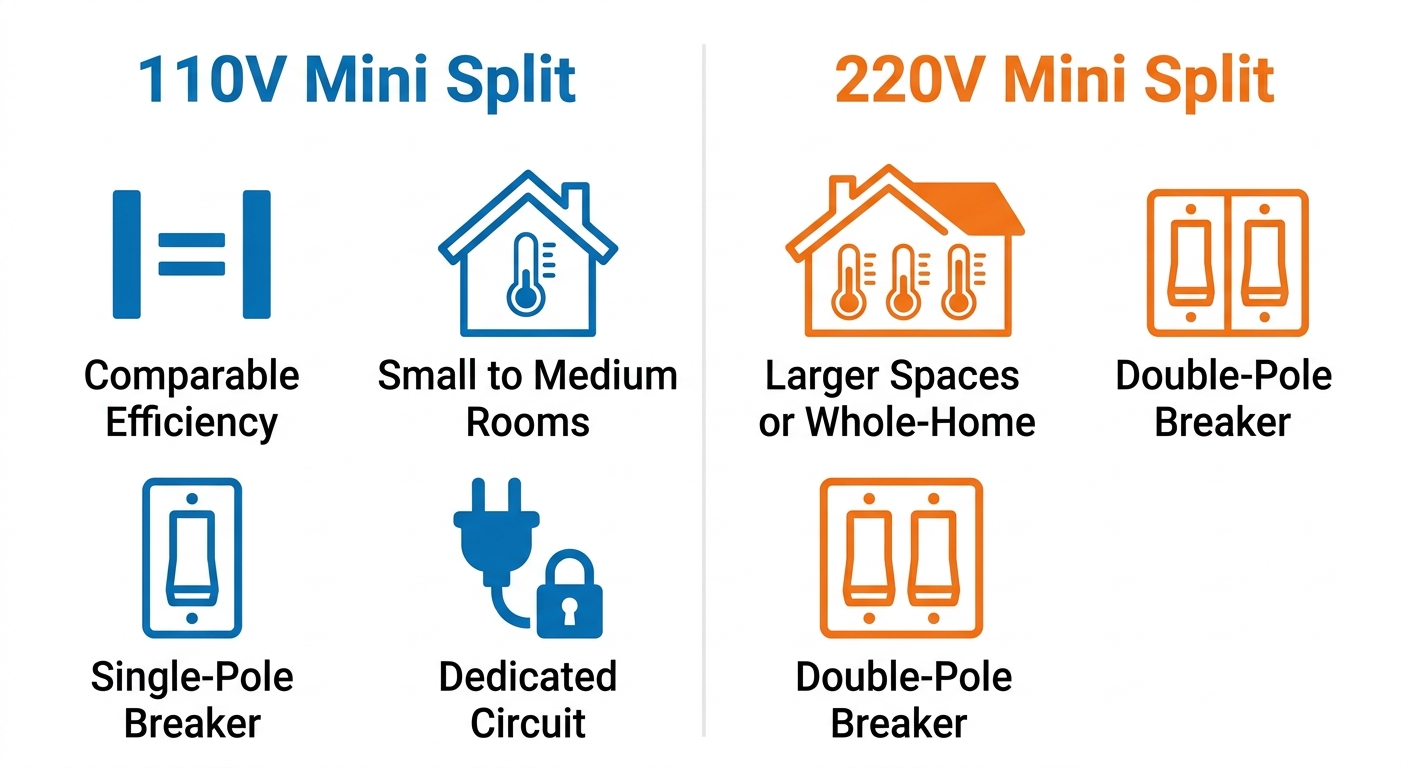
Mini-splits run off either 110V or 220V. Capacity, measured in BTUs, largely determines which voltage platform a mini-split will require. Most 110V models can handle up to about 12,000 BTU. This works well when you need to cool one room, a home office, or perhaps your studio apartment if you live near Los Angeles. But once you exceed this temperature rating, you might be better off going to 220V. The reason is that once the cooling or heating load exceeds that threshold, the amperage draw on a 110V circuit becomes impractical, so 220V is the safer choice for larger loads.
If you double up on volts, the current is cut in half for the same wattage. This lets 220V use thinner conductors and smaller breakers for the same power.
There is variation in circuit breaker setup: 110v models need a large single pole switch, whereas a corresponding 220v model will have two poles that go up to the size needed for the specific unit being used.
Real-World Energy Consumption Patterns
The reality of energy consumption indicates that voltage plays only a small role when comparing against other factors such as SEER ratings, local utility costs and how people operate their systems. How much it costs to run a mini split depends far more on SEER rating, insulation levels, and hours of operation than on whether a unit uses 110V or 220V alone.
It happens that start-ups are problematic: a motor-driven appliance draws a brief surge current from the mains as its compressor fires up, and a 110 volt unit shows more spiking than its 220 volt equivalent at the same power rating. An inverter driven min split mitigates this somewhat by ratcheting itself up slowly instead of all at once, thus smoothing out the spike on the circuit.
Whether or not mini splits become more affordable as you upgrade to 220 volts depends largely on your decision-making process and selection criteria for the right size, higher efficiency units. Any savings, if they occur, stem from choosing an appropriately sized, higher-efficiency unit rather than from the increased voltage itself. Because steady-state operation at either voltage uses about the same electricity per Btu, we recommend getting a properly sized high SEER rated unit along with a high quality professional install in order to maximize seasonal performance in Culver City and the greater Los Angeles area.
Choosing Between 110V and 220V for Your Home Mini Split
If you’re in Culver City and have to choose between 110v or 220v, the decision starts with your panel capacity. This section will provide some guidance based on different reasons for your decision making process.
| Factor | 110V Setup | 220V Setup |
|---|---|---|
| Typical BTU Range | 9,000–12,000 BTU (single-zone) | 9,000–36,000 BTU (single and multi-zone) |
| Breaker Size | Single-pole 15A or 20A | Double-pole 15A to 30A |
| Wire Gauge | 14 AWG or 12 AWG copper | 14 AWG to 10 AWG copper |
| Common Applications | Small rooms, apartments, additions where 240V panel access is limited | Larger living areas, open floor plans, whole-home multi-zone systems |
These are general guidelines; always verify your equipment’s nameplate specifications.
Assessing Your Home’s Electrical Panel Capacity
When choosing voltage for the minisplit, inspect your breaker panel first. You’ll want to find a free slot since each ductless system needs its own dedicated circuit. According to the National Electrical Code (NEC), there must also be a disconnect switch within sight of the outdoor unit, allowing the circuit to be completely de-energized during service. After selecting the right circuit, the wire method changes depending upon whether the run travels through interior walls in the finished portion of the structure or whether it exits into the exterior or is located in any unfinished area. Inside interior areas, NM-B cable can be used, however any run that exists externally or in any location other than the finished part of a building will need to use individual THHN conductors inside of either EMT or PVC conduit. This requirement is based on the NEC. Finally, check out the MCA and MOCP figures from the equipment nameplate, which supersede generic wiring tables.
Matching Voltage to Room Size and Cooling Needs
After confirming your panel can support a new circuit, focus on the area you intend to cool. A small bedroom or home office up to about 400 square feet typically needs a 9,000 to 12,000 BTU mini split, which is available in both 110V and 220V configurations. Voltage selection for mini splits of this size often depends on practical factors: if your panel already has 240V circuits or the outdoor unit is far from the panel, a 220V setup is beneficial—lower current reduces voltage drop. For reference, a 9,000 BTU unit on a 14-AWG 240V circuit can run 163 feet before reaching a 3% voltage drop. Larger open-plan spaces approaching 1,000 square feet call for 18,000 to 24,000 BTU units that operate almost exclusively on 220V, requiring double-pole breakers rated from 20 to 30 amps. Plan on 110V only for modest cooling demands of 12,000 BTU or less where your panel can accommodate a dedicated single-pole circuit.
When to Consult an HVAC Professional
Although many homeowners can perform even a rudimentary panel check, some situations demand the guidance of a licensed HVAC professional. When your home still carries an outdated fuse box or only 60-amp service, then its electrical capacity makes a mini split impossible to install. At that point, a full service upgrade must occur before installation. Likewise, when you need a panel upgraded from 100-amp to 200-amp service, or when you plan a multi-zone system that will simultaneously power several indoor units, a qualified electrician must calculate the total load and obtain permits. As a Culver City heating company that’s been operating within the area since 1998, Culver City Heating & Cooling Climate Control can guide the process through and through. We stand behind our work with a simple commitment: should we make a mistake, we’ll do everything in our power to correct it to your satisfaction. After figuring out which voltages are needed, the rest of the installation needs to stick to the set codes and wiring standards as a whole if you want to ensure safe and effective performance.
Wiring and Code Requirements for Mini Split Installations
After you’ve figured out which type of voltage should be used on your mini-split unit, make sure that you understand all of the proper wire types and codes needed in order to comply with the necessary regulations.
Dedicated Circuit and Disconnect Mandates
NEC Article 440.14 mandates that all mini-split heat pumps must have their own dedicated branch circuits – i.e., they cannot be shared with any other devices or outlets. An accessible disconnect switch needs to be installed within sight of the outdoor unit so a technician can safely cut power during service. The rule applies regardless if your system operates at either 110 volts or 220 volts.
| Requirement | 110V Configuration | 220V Configuration |
|---|---|---|
| Dedicated Circuit | Same as NEC requirement | Same as NEC requirement |
| Disconnect Switch | Same as NEC requirement | Same as NEC requirement |
| Conductor Type | Same as NEC requirement | Same as NEC requirement |
| Voltage Drop | Same as NEC requirement | Same as NEC requirement |
Indoor and Outdoor Conductor Selection
Where the wiring is installed determines which materials are acceptable. Inside finished walls, standard NM-B cable performs well because it is protected from moisture and physical damage. Once the run passes through an exterior wall or travels along the side of a house, individual THHN conductors enclosed in EMT or PVC conduit become mandatory.
Voltage Drop Limits for Branch Circuits
NEC suggests keeping the voltage drop for branches circuits below three percent in order to ensure efficient operation of equipment as well as avoid premature wear of components. For example, 14 AWG copper can run up to around 163 feet on a 240 volt circuit supplying a 9,000 BTU unit without exceeding this limit. In contrast, it will be able to stretch further if you have a 24,000 BTU unit and the wire size is 10AWG – we are talking approximately 181 feet here. However, it has been stated above, that even bigger distances would require greater conductor size so this calculation should always be performed when doing a professional installation.
Shannon K. Culver, HVAC content specialist, contributed research to this section.
Common Questions About Mini Split Voltage Selection
The voltage you pick when setting up your mini split will influence the efficiency, heat pump size needed, and how simple installing it is, all things which we think about during each call.
In terms of the size of a typical Culver City home, a 110V unit would usually work better for spaces such as bedrooms or small offices where you don’t need as much power. For bigger rooms that require more space to fill or faster heating and cooling response, a 220V system is better suited. What suits a typical Culver City home?
Is 220 volts better? Lower currents drawn from a 220 volt line will result in less electrical loss, yet any real savings depends upon how the system is wired as well as the operating conditions. In addition, most models requiring this voltage need their own separate circuits while some running off of 110 volts can be plugged into outlets already in place. Is 220V more efficient?
This will enable you to evaluate the practicality of your situation so that you can confidently talk about which voltages to use.
Making the Right Voltage Choice for Your Mini Split
To answer whether it is better to run a mini split on 110 or 220, we carefully consider your Culver City home’s specific setup. Efficiency, existing wiring, and equipment compatibility all influence the decision, and the ideal voltage depends on your installation scenario, not a universal rule. We recommend a professional assessment from our technicians. Trademarks remain the property of their respective owners; brand names are for identification only. Copyright 2026 © Culver City Heating & Cooling Climate Control.
Get Expert Mini Split Advice
Now that you understand the key factors influencing voltage choice, from electrical panel capacity to NEC wiring standards, you can make an informed decision. Every home is unique, so a professional assessment ensures safety and optimal performance. Our certified technicians have been helping homeowners in Culver City and throughout the Los Angeles area since 1998. We can evaluate your existing electrical setup and recommend the right mini split voltage for your comfort needs. Reach out to us at (424) 543-6788 or schedule a consultation online. Let our expertise guide your installation for efficient, trouble-free cooling.